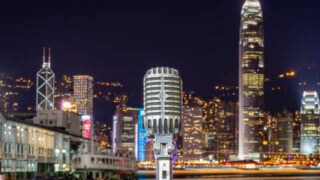
Hong Kong might be synonymous with skyscrapers, yet it has a huge amount of green space and an amazing array of wildlife. Here, we continue our nature series with a look at some facts, trivia and tips about the trees of Hong Kong.
#1 Greener than you think
With its countless high-rise buildings, trees aren’t the first thing that come to mind when you think of Hong Kong. However, 40 percent of the territory consists of country parks – and around 23.8 percent is forest. (In mainland China, it’s 21.7 percent.) Also, because of our “transitional climate”, within those forests is a quirky mix of tropical and temperate-zone trees – from the Mexican Fan Palm and the Purple Camel’s Foot, to the Elephant’s Ear and the Rigid Bottle Brush.
#2 Let them grow!
It wasn’t always so lush. Hong Kong suffered deforestation for centuries. Great swathes of greenery were felled for tea plantations, for example, and in WWII, occupying Japanese forces used trees relentlessly for fuel. By 1945, just four percent of the land was forested. Thankfully, recent reforestation programmes are repairing the losses. At Kadoorie Farm, 25,000 seedlings a year are produced for use in reforestation efforts.
#3 Wall wonders
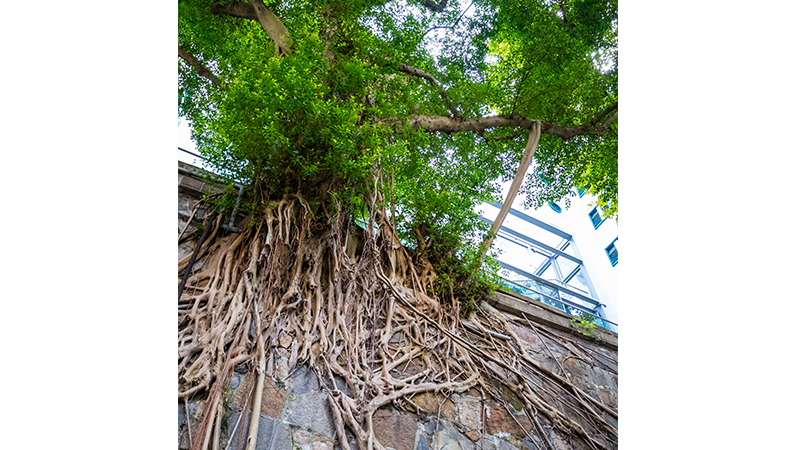
Hong Kong “stone wall trees” developed after masonry walls were constructed in the 19th and 20th centuries to prevent landslides. Banyans and other hardy species sprouted between the joins, growing to maturity in their urban settings. By the mid-1990s, there were more than 1,200 of them. Recently, though, some have been targeted for removal. A well documented example is on Bonham Street, where 80-year-old banyans were controversially removed in 2018 because they were deemed a safety risk.
Today, a good place to see stone wall trees is along a stretch of Forbes Street in Kennedy Town.
#4 Protecting significant trees
In 2004, the government established the Register of Old and Valuable Trees. This is list of trees across the territory that are distinguished by their age (over a century old), rarity, size, outstanding form or cultural significance. Around 430 trees are on the register. Location is important too: these are trees located within built-up areas and tourist attraction spots in village areas. Find out more here.
#5 Naming a city
Hong Kong takes its name from a tree. “Fragrant harbour” comes from a reference to the incense tree, or Aquilaria sinensis. The tree’s fragrant, resinous wood, called agarwood, is used in making incense – and Hong Kong was once an important hub for its commercial export. Unfortunately, because agarwood is so highly prized – and priced! – the remaining trees today are regularly poached. Some say that the species is close to extinction in HK, though thankfully there are efforts afoot to tackle the poaching and replenish stocks.
#6 Lucky limbs
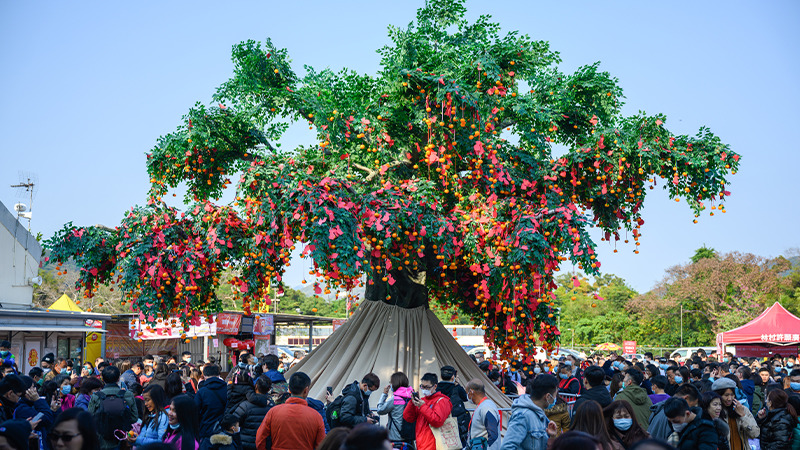
In the New Territories village of Fong Ma Po, you’ll find the famous Lam Tsuen Wishing Trees. Hongkongers flock to these, especially during Chinese New Year, to make wishes. First, you write your wish on a piece of coloured joss paper; next, you tie your piece of paper to an orange; finally, you throw the orange up into the branches of the tree. If an orange stays stuck in the branches, it’s said, the wish will come true!
#7 Insta-appeal
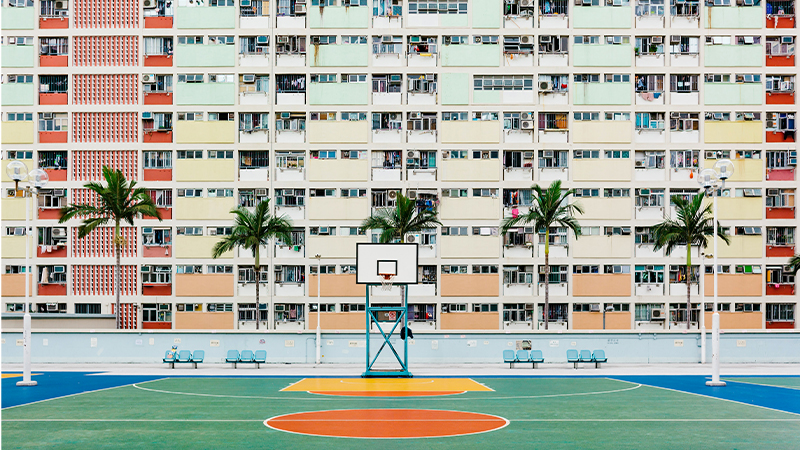
Thanks in part to a humble row of palm trees, Choi Hung Estate in Kowloon has become a hotspot for Instagram pics. Choi Hung means “rainbow”, and the estate is aptly decked out in striking colours. Add to that the flat, stark basketball court in front, and the aforementioned line of individually spaced palms that wonderfully offset the building in the background, and you have Instagram gold.
#8 Typhoon trouble
It’s a good thing there’s lots of replanting going on in Hong Kong – the place needs it after the devastation of recent typhoons. According to the Development Bureau, over 60,000 reports of uprooted trees were received during Typhoon Mangkhut in 2018. In 2025, Typhoon Ragasa toppled a historic 50-year-old banyan at Oi Man Estate in Kowloon.
#9 Seeing red
If you love the look of autumn leaves, the Hong Kong countryside has a few surprises in store. From November to January, the leaves on the trees in the Tai Tong Sweet Gum Woods display a range of red and orange shades, in stark contrast to the surrounding evergreens. Tai Tong might be off the beaten track for most of the year, but for the autumn display, it’s a full house. Don’t forget your camera!
#10 Pretty portraits
While the best way to appreciate the beauty of Hong Kong’s trees is to get out and explore the green spaces, Portraits of Trees of Hong Kong and Southern China is a lovely book that celebrates the diversity of trees in HK, with over 100 detailed watercolour paintings by Sally Grace Bunker, an acclaimed botanical artist.
This article first appeared in Expat Living magazine. Subscribe now so you never miss an issue!
Liked this? Find more features in our nature series here:
- Birds of Hong Kong: 10 Things to Know
- Snakes of Hong Kong: 10 Things to Know
- Insects of Hong Kong: 10 Things to Know
Read more on nature and wildlife in Hong Kong in our living in Hong Kong section.