
Ida Laura Pfeiffer (1797–1858) – dubbed “the world’s first solo female travel writer” – was a mother of two who set out from her home country of Austria in her mid-40s for a series of global journeys. She is said to have covered 32,000 kilometres on land, and almost eight times as far by sea, covering the Americas, Africa, the Middle East and Southeast Asia.
Ida visited Hong Kong in 1848, just a few years after it had become a British colony. Her recollections in a later travel memoir, A Woman’s Journey Around the World (1850), paint a not-so-flattering picture of life for the early expats in “the port of Victoria.”
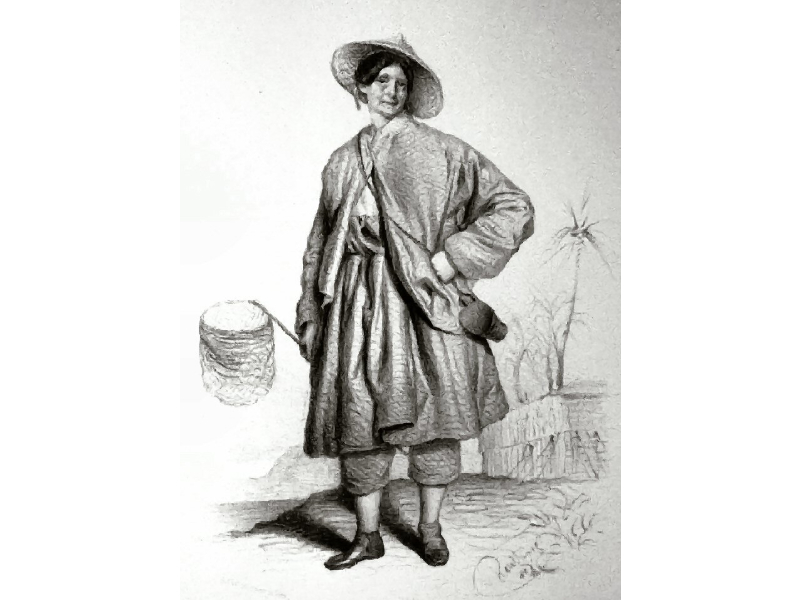
On business:
“The Europeans who have settled here, not more than two or three hundred in number, are far from being contented, as trade is not half as good as they at first expected it would be.”
On real estate:
“Every merchant is presented by the English government with a plot of ground, on condition of his building on it. Many of them erected splendid edifices, which they would now be glad to sell for half the cost price, or even very frequently to give the ground and foundations, without asking the smallest sum in return.”
On women:
“I was struck at seeing no native women in the streets, from which it might be concluded that it was dangerous for a European female to walk about as freely as I did; but I never experienced the least insult or heard the slightest word of abuse from the Chinese.
On the language:
“No language is so difficult to read and write as the Chinese; it contains more than four thousand characters and is wholly composed of monosyllables. Little brushes dipped in ink are used for writing, which extends down the paper from right to left.”
Incredible to think that those first settlers were giving their homes away – in a place that today has the least-affordable housing market on the planet!
When Ida left Hong Kong, it was aboard an English steamer called Pekin, making for Singapore. Unimpressed with the “exorbitant” cost of tickets (US$76 for first class), she asked for a cheap third-class berth instead, but was advised against it because the passengers in that class were “not respectable”. She settled for second class – with a couple of regrets, judging from her account of dinner:
“The tablecloth was full of stains… the knives and forks had notched blades and broken prongs. On the first day we had no spoons at all; on the second we had one between us, and this one was placed on the table in solitary grandeur during the entire voyage.”
These complaints would seem trivial in view of what transpired in Ida’s later journeys. For instance, she was robbed and injured in Brazil, and threatened by knife-wielding cannibals in Sumatra. To escape the latter, she used a phrase she’d learnt in their own language: “Don’t eat me. I am an old woman, so my flesh is very tough.” Her eventual death at 61 was likely from malaria, contracted during a trek through swampy terrain in Madagascar.
This article on Ida Pfeiffer first appeared in the Autumn 2026 issue of Expat Living magazine. You can buy the latest mag or an annual subscription, or read the digital version for free now.