
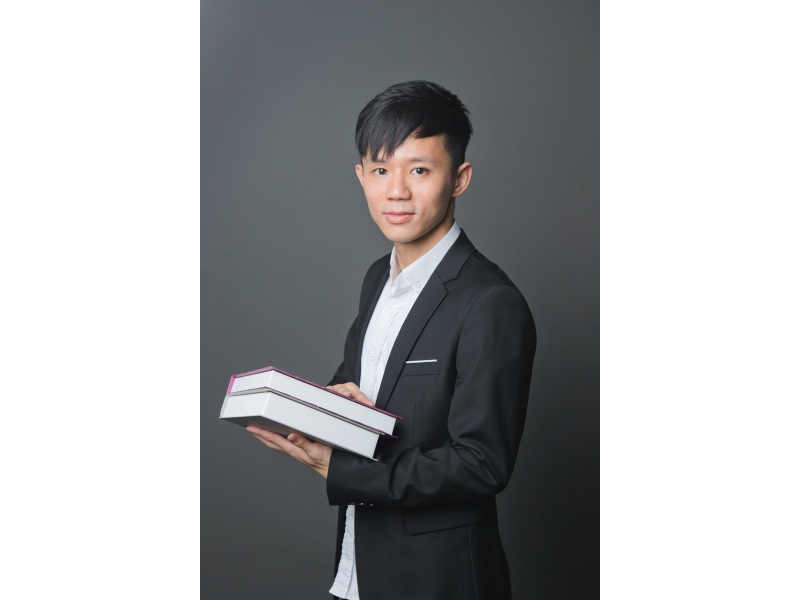
Plenty of kids struggle with maths at school. For some, it’s a case of occasionally finding concepts and questions difficult, especially areas such as algebra, or balancing study time with a busy school schedule and demanding curriculum. For others, there’s a more persistent underlying learning gap that can affect their confidence and overall progress. Here, maths tutor VIC LI shares insights from his experience teaching international and boarding school students – including what parents can do.
What are some red flags for parents around their child’s maths ability and performance? Is it only about poor grades?
I don’t think looking for a maths tutor necessarily means that a student is struggling or getting poor grades. Students come to me for very different reasons. Some are having trouble with maths, but others are already performing well and want to push themselves further. Some have a genuine interest in the subject and want to learn beyond what they are doing at school, while many seek tutoring because they’re preparing for an important examination.
So, grades are only one indicator. A drop in grades can certainly be a sign that a student needs additional support, but parents can also pay attention to changes in confidence, whether their child is finding it increasingly difficult to keep up with the course, or whether they have a particular academic goal that requires a stronger level of maths. The need for a tutor really depends on the individual student and what they’re trying to achieve.
What are some common gaps you see with students and their approach to maths?
Mathematics has its own language, and I think algebra is a large part of that language. Many mathematical concepts are abstract, and a lot of students who struggle with maths have weaknesses in algebra from their earlier years. Perhaps they didn’t fully understand it when it was first taught, or there was simply a point where they got stuck and never properly caught up. Once a student becomes comfortable with the language of algebra, many other areas of the subject become much easier to understand.
Is poor maths test performance sometimes just tied to bad study habits or careless mistakes?
Yes. Some students feel that they understand the maths, but their test and examination results don’t reflect that understanding. Very often, what they are missing is practice. In an exam, students are not being asked to be Albert Einstein and invent a new mathematical theory. The solution already exists; they need to understand the mathematics and learn how to apply it.
Understanding something once, however, doesn’t mean you can use it when you need it. It’s a little like learning to ride a bicycle: you can understand how cycling works, but you still need to practise before it becomes something you can do naturally. Maths is similar. Practice helps students put different methods into their mental “toolbox”, so that when they encounter a problem again, they know which tool to use.
What students sometimes call “careless mistakes” can also be related to this. With enough practice, they become more familiar with the steps involved and are less likely to make the same mistakes under exam pressure.
How do you assess a child’s current standard in maths before starting tutorials?
Before the first lesson, I ask parents about the student’s background and recent test or examination results. I then use the lesson mainly to understand the student. I work through questions to see how they approach mathematics and the methods they use; I pay particular attention to basic algebra, because weaknesses there can affect many other areas of maths. I’m not only looking at whether a student can get an answer right, but also at how they think and where their blind spots may be.
To help me understand their confidence in maths, I also ask them about their past experience with the subject. Every student is different, and over more than 17 years of tutoring, I have developed this approach to help me identify what each student actually needs before deciding how their lessons should proceed.
What kind of tutoring programmes do you offer, and what ages and grades do you work with?
I mainly offer maths tutoring for international curricula, including the IBDP, IGCSE, GCSE, A-Levels, SAT and UKiset. UKiset, for example, is an assessment for students aged between 9.5 and 18 who may be applying to British independent schools. For younger students, this is an important stage for developing mathematical sense, logical thinking and problem-solving skills. Teaching students at this age often requires extra patience and care.
For secondary school students, the approach is different. Teenagers are generally able to focus on more specific academic goals, such as preparing for the IBDP, SAT or other examinations. At the same time, I think it’s important to understand each student’s character and guide them in a way that suits them, rather than simply teaching the syllabus.
I also teach university-level mathematics, particularly for students taking it as part of science, engineering or business-related degrees.
How do you report on a child’s progress?
For all my secondary school students, I send parents a monthly feedback report covering three main areas: the student’s learning progress, their attitude towards learning, and an expected grade based on their current performance and recent assessments.
Parents are often busy and may not always have a clear picture of how their child is progressing in maths, so regular communication between the tutor, student and parents is very important. The report gives parents a clearer and more objective picture of where their child currently stands, rather than simply saying that they are “doing well” or “improving”.
What does a typical maths tutor session look like?
My lessons are conducted online through Zoom, which makes it convenient for us to write and work through maths together. It also provides a comfortable and professional environment for learning.
I normally have a clear lesson target based on the student’s course syllabus. I first teach and demonstrate the relevant concepts, and then ask them to work through examples themselves. This is a very important part of the lesson because it allows me to observe how they think and where they may be having difficulties. I believe a tutor is not only a teacher, but also an observer. Understanding the student is an important part of teaching.
I may also assign homework, though I try to make sure the workload is appropriate. We normally aim to complete the syllabus ahead of the school schedule, so that there is enough time in the months before the final examination to focus on past papers and exam preparation.
Can you give a couple of specific examples of your students who’ve achieved a notable turnaround with maths?
Every year, I teach students preparing for examinations such as the IBDP, IGCSE, GCSE and A-Levels, and many go on to achieve top grades. In 2026, for example, some of my IB Mathematics students achieved Grade 7 out of 7. I have also had students achieve Grade 9 in GCSE Additional Mathematics and A* at A-Level.
Some students have made particularly significant progress. I’ve had students who were achieving around Grade 4 when they began the IB syllabus but eventually achieved Grade 7 in the final examination. This is not only because of my tutoring – the student’s own effort and commitment are just as important.
More examples of results can be found on the Vic Li Math website.
Why is success in maths at school important?
I think there are two sides to this: academic achievement and personal development.
Academically, many secondary school and university subjects rely heavily on maths, including physics, chemistry and economics. A strong maths foundation therefore affects not only a student’s school results, but also the choices available to them in their future studies.
On a personal level, learning maths develops logical and analytical thinking. Students learn how to break down a complicated problem, understand the information they have, and work towards a solution. I think these are fundamental skills for dealing with problems in life, not just exams. In that sense, learning mathematics is also a way of training students to think.
How can parents help a child who might be struggling with the subject?
Students need to want to improve themselves. Parents can’t force them to do it, and neither can a tutor. The first step is therefore to build a common goal with the student and help them develop their own motivation to improve in maths.
Often an important turning point is when students begin to build confidence and genuinely want to improve. Some students are naturally curious and interested in particular areas. Others don’t have a special interest in the subject. In those cases, I try to help them understand why their results are important, while also showing them that maths may not be as difficult as they think, and that they are capable of doing well. Once we share the same goal, students are much more likely to take an active role in their own learning.
For parents, one of the most useful things they can do is find the right maths tutor – someone who can not only teach but also help their child build confidence and develop the motivation to improve.
About this maths tutor
Vic Li has been teaching maths for over 17 years. He has a Bachelor of Science in Mathematics from The Chinese University of Hong Kong and a Master of Financial Mathematics from The University of Queensland. From 2016 to 2020, Vic taught at one of Hong Kong’s largest education centres, before focusing on private tutoring. Today, he teaches students preparing for public examinations such as the IBDP, IGCSE, GCSE and A-Levels, as well as undergraduate students studying university-level maths.
Find out more at viclimath.com or WhatsApp Vic Li at 9300 1370.
See our Living in Hong Kong section for more features like this.