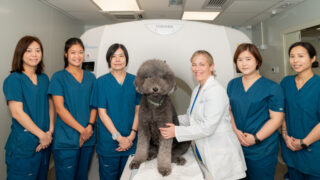
From unexplained weight loss to a cough that will not settle, sometimes a pet’s illness needs more than another round of medication. According to DR LAWREN DUROCHER-BABEK, veterinary internal medicine – including procedures like pet CT scan and endoscopy – can help families in Hong Kong move from uncertainty towards a clearer plan.
Most pet owners know when something is not quite right. It might be that your dog is eating normally but continuing to lose weight. Or your cat may be vomiting every few days, even though blood tests haven’t revealed an obvious cause. Or perhaps your beloved furry companion simply seems quieter, less interested in food and not quite themselves.
Your family veterinarian will usually be the first person to assess these changes, and many illnesses can be identified and treated successfully in general practice. But when a pet’s symptoms persist or the diagnosis remains unclear, or when several body systems may be involved, your vet may recommend an internal medicine consultation.

As Dr Lawren points out, that doesn’t necessarily mean something terrible has been found. It just means the problem deserves a deeper look. We hear more about the work she does at Veterinary Specialty and Imaging (VSI) in Hong Kong.
What is veterinary internal medicine?
I often describe it as the part of veterinary care concerned with the problems we cannot easily see from the outside.
Small animal internal medicine includes diseases affecting the stomach and intestines, liver, pancreas, kidneys, bladder, lungs, blood, immune system and hormone-producing organs. Internists frequently help pets with chronic vomiting or diarrhoea, unexplained weight loss, anaemia, recurrent fever, excessive thirst, breathing problems, kidney disease, diabetes and other complicated or overlapping conditions.
At VSI, we also regularly see pets’ symptoms that don’t fit neatly into one category. These are the medical puzzles that require us to step back, review the whole history, and ask whether other signs might be connected.
My role isn’t to replace the family vet. Specialist care works best as a collaboration between the pet owner, the primary veterinarian and the specialist. Your regular vet knows your pet’s history and provides essential continuing care. The specialist contributes advanced training, diagnostics and experience with less common or particularly complex illnesses.
When should an owner consider taking their pet to a specialist?
There is no single rule, and referral doesn’t need to be reserved for a crisis. It may be helpful when:
- a condition isn’t improving as expected;
- symptoms repeatedly return;
- several tests have produced conflicting information;
- your pet has more than one illness requiring coordinated care; or
- a procedure is needed that is not routinely available
in general practice.
Common reasons for referral include:
- vomiting, diarrhoea or appetite changes lasting several weeks;
- unexplained weight loss;
- persistent coughing, sneezing, nasal discharge or noisy breathing;
- abnormal liver, kidney or blood results without a clear explanation;
- recurrent fever, anaemia or infections;
- excessive drinking or urination;
- concern about a mass or possible cancer; and
- managing several chronic illnesses at the same time.
Owners sometimes arrive feeling that they have “already tried everything”. In reality, they may have gathered several valuable pieces of the puzzle. Part of the consultation is organising that information, deciding what it may mean, and identifying the next step most likely to provide a useful answer.
Where does CT scanning help?
A CT scan creates detailed, cross-sectional images of the body. Instead of looking through overlapping structures like with a standard X ray, CT allows us to examine the area in thin layers and reconstruct it from different angles.
This can be particularly useful for diseases of the nose, sinuses, skull, neck and chest. It may also help us investigate abdominal masses, certain spinal problems, complex fractures and diseases that can’t be fully characterised with X-rays or ultrasound alone.
For example, a cat with months of nasal discharge may have inflammation, a foreign object, a fungal infection or a growth. These problems can produce similar signs but require very different treatments. CT can show where abnormal tissue is located, whether bone has been affected, and where a biopsy may be useful.
Similarly, when a mass has been identified, CT may help determine its size and structure, and whether surgery or another treatment is realistic.
A CT scan doesn’t replace clinical judgement or always provide a final diagnosis. But it gives us a much more accurate map for choosing the safest and most informative next step.
Pets must remain completely still for diagnostic images, so sedation or a short general anaesthetic is often required. The most appropriate approach depends on the pet, the part of the body being examined, and the information we need. Benefits and risks should always be discussed before proceeding.
What can endoscopy tell us?
Endoscopy allows us to look directly inside parts of the body using a small camera attached to a flexible or rigid instrument.
A gastrointestinal endoscope can be passed through the mouth to examine the oesophagus, stomach and upper intestine, or through the rectum to examine the colon. Rhinoscopy examines the nasal passages, and bronchoscopy the airway.
The advantage is not simply being able to see an abnormality. During many endoscopic procedures, we can collect small tissue samples for laboratory analysis. In selected cases, we may also be able to remove material, such as a foreign object, without making a surgical incision.
Consider a dog with chronic vomiting. Blood tests and ultrasound may narrow the possibilities, but conditions such as chronic inflammation and some intestinal cancers can appear very similar. Examining tissue under a microscope may be necessary before we can recommend the most appropriate treatment.
Endoscopy can often obtain these samples in a less invasive way than abdominal surgery, although it can’t reach every part or every layer of the intestinal tract.
How do you weigh up which procedure to recommend?
Advanced medicine shouldn’t mean performing every available test. It should mean selecting the test most likely to help that individual pet.
Before recommending a procedure, I consider what we already know, which diagnoses remain possible, how the result could change treatment, and whether the information gained justifies the cost and risk.
Sometimes the right next step is CT or endoscopy. Sometimes it’s a carefully chosen blood test, an ultrasound, a medication trial or simply monitoring a stable patient. And sometimes a family decides that comfort and quality of life matter more than pursuing a definitive diagnosis.
These are all valid medical decisions when they are made with good information and a clear understanding of the options.
What else would you like readers to know about internal medicine and their pets?
For most families, the hardest part of a complicated illness is not learning a medical term; it’s living with uncertainty. They want to know:
- Is my pet uncomfortable?
- Is this treatable?
- What happens next?
- How quickly do we need to decide?
- What can we realistically manage at home?
A successful internal medicine consultation should help answer those questions. Even when we cannot cure a condition, we can often control symptoms, protect quality of life, and give the family a clearer sense of what to expect.
Pets are part of our families. When they are unwell, the whole household feels it. My goal is therefore not only to investigate the illness, but also to make sure the people caring for that pet understand the findings, feel heard, and leave with a plan that makes sense for their family.
Dr Lawren Durocher-Babek is a board-certified specialist in small animal internal medicine and is certified in animal hospice and palliative care. She practises at Veterinary Specialty and Imaging in Fortress Hill.
VSI is at Shop 103A, Victoria Centre, 15 Watson Road, Fortress Hill.
3610 9121 | [email protected] | hkvsi.com
This article first appeared in the Autumn 2026 issue of Expat Living magazine. You can buy the latest mag or an annual subscription, or read the digital version for free now.